Get Your Business Found on Google (and Stand Out Locally) in 2026
If you’ve ever typed “coffee near me,” “plumber in [your city],” or “best hair salon open now,” you’ve already experienced the magic of local search.
And if you own one of those coffee shops, plumbing businesses, or salons? Local search might just be the most powerful (and underrated) marketing channel you have right now.
Let’s be real — the internet feels noisier than ever. But here’s the good news: people still turn to Google when they’re ready to buy locally. And according to the 2026 Local Search Ranking Factors report by Whitespark, understanding how to show up in those local results could be the difference between steady growth and digital invisibility.
Wait — what is local search, exactly?
Local search is how Google helps people find businesses near them.
Think of it like a digital word-of-mouth map. When someone searches “best pizza in Santa Cruz,” Google doesn’t send them to a random blog post about pizza. It shows them a map — with actual local pizza shops, ratings, hours, and directions.
Those results (often called the local pack or map pack) are powered by data from your Google Business Profile (GBP) — the free listing where your business name, address, phone number, website, reviews, and photos live.
Getting your business to show up there — and higher than your competitors — is the name of the game.
Why local search matters more than ever
While AI-driven platforms like ChatGPT and Google’s Gemini are shaking up how people find information online, local searches have held their ground.
As Darren Shaw, author of Whitespark’s 2026 report, notes:
“Research and discovery of local businesses is still predominantly done through Google’s local results because it’s a much better experience for local intent queries than LLM responses.”
Translation? People still trust Google Maps more than chatbots when they need a roofer, not a recipe.
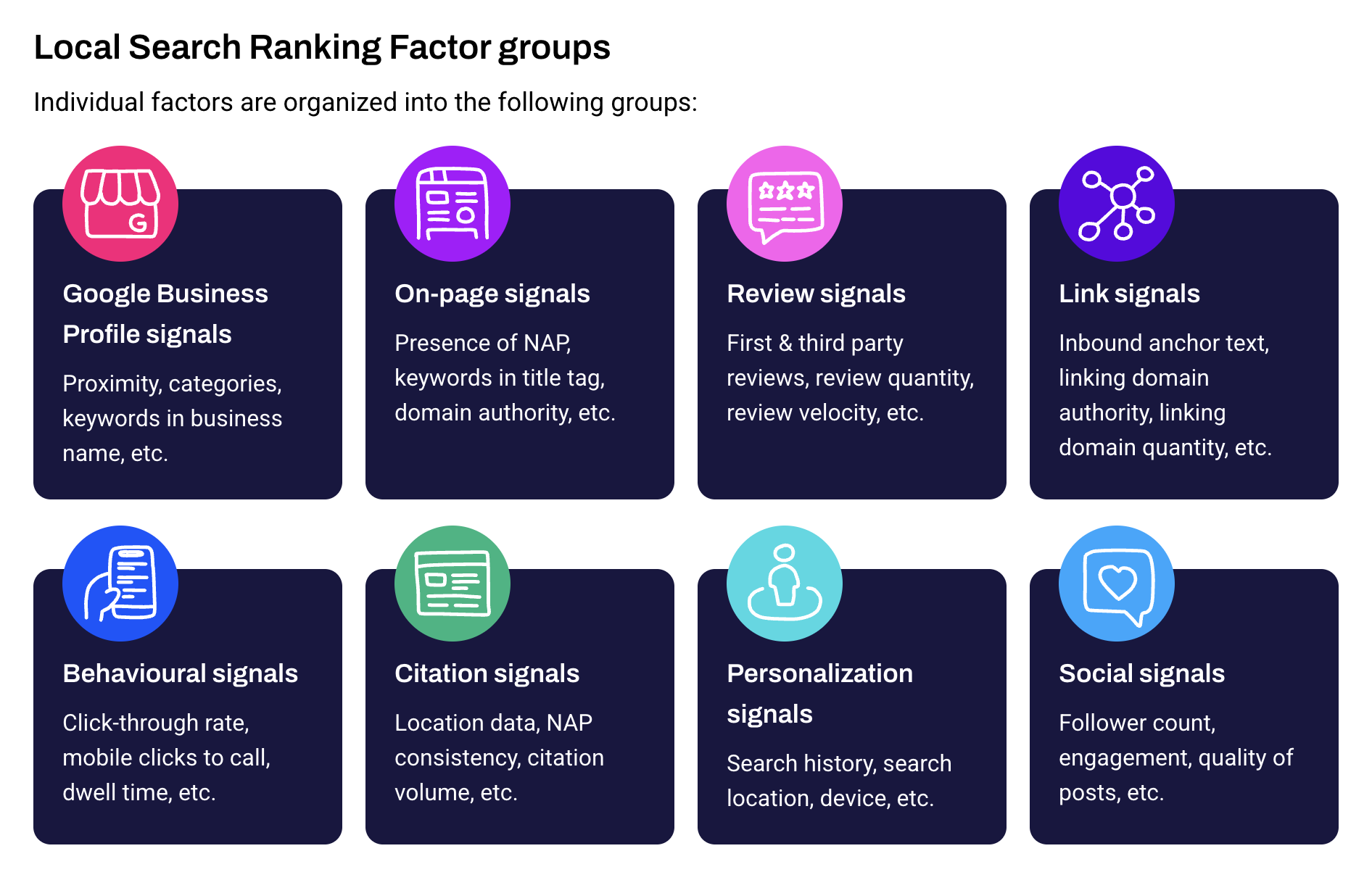
The biggest shifts in 2026 (and what they mean for you)
🧾 1. Reviews and reputation matter more than ever
Reviews aren’t just “nice to have” anymore — they’re ranking gold.
Businesses with a steady stream of positive Google reviews (especially recent ones) tend to show up higher in the map pack. And it’s not just about quantity — Google’s also paying attention to review sentiment and how often you reply.
Pro tip: Ask for reviews right after a great customer experience. Respond to every single one — even the tricky ones — with empathy and professionalism.
📱 2. Behavior signals are on the rise
Google’s watching how people interact with your listing.
Clicks, calls, requests for directions, and how long someone spends on your website — they all send positive “trust” signals.
So, if your listing looks sharp, your info’s accurate, and your website loads fast on mobile? You’re already winning.
🧭 3. Citations are quietly making a comeback
For years, marketers said citations (your business info listed consistently across directories like Bing, Yelp, OpenTable, Houzz, Trip Advisor, etc. depending on your industry ) were “dead.” But in 2026, they’re back in the spotlight — especially for AI-driven visibility.
Mentions of your business in local blogs, news sites, or directories help search engines confirm you’re a real, trustworthy business in your community.
Hot tip: Make sure your business name, address, and phone number (NAP) are consistent everywhere — from Yelp to your local Chamber of Commerce site.
🤖 4. AI search visibility is the new frontier
This year’s report introduced a brand-new category: AI Search Visibility — meaning how well your business shows up in AI-generated answers.
Factors like being featured on “best of” lists, having complete service pages, and earning mentions on reputable industry sites now boost how visible your brand is in AI-driven results like Google’s “AI Overview.”
It’s a fancy way of saying:
If people online are talking about your business (and your info’s accurate), AI’s more likely to talk about you, too.
Simple steps to boost your local visibility
If you’re reading this thinking, “Okay, this sounds great, but where do I start?” — I got you. Here’s where to focus first:
1️⃣ Optimize your Google Business Profile.
Make sure your hours, categories, and services are accurate. Add real photos, keep your updates fresh, and turn on messaging if it suits your business.
BONUS: Download our free step-by-step guide showing you exactly how to do this.
2️⃣ Get (and respond to) reviews regularly.
Set up a simple process to request reviews from happy customers. Bonus points if you personalize your reply — it builds trust and engagement.
3️⃣ Make your website local-friendly.
Each service or location deserves its own page. Use clear language like “Family-owned plumbing services in Austin” to help search engines (and humans) know where you operate.
4️⃣ Be consistent across the web.
From Facebook to Yelp, make sure your NAP (name, address, phone) details match exactly. Inconsistencies can confuse Google — and potential customers.
5️⃣ Engage locally, online and off.
Sponsor a community event. Collaborate with a nearby business. Pitch a local news story. The more local “mentions” you earn, the more credible your business appears online.
What not to do (the stuff that tanks your visibility)
🚫 Don’t stuff keywords into your business name (“Joe’s Pizza Best Restaurant Near Me”).
🚫 Don’t use fake addresses or virtual offices — that’s a fast track to suspension.
🚫 Don’t neglect your hours or leave your profile half-empty. Google loves active, accurate listings.
Looking ahead: Local SEO meets AI
As AI continues to shape how people search, local SEO is evolving — not disappearing.
If you stay focused on trust, relevance, and accuracy, you’ll be ready for whatever the algorithm throws next.
Because at the end of the day, Google’s goal (and your customer’s goal) is the same: help people find the right local business, fast.
Final thoughts
Local SEO isn’t about gaming the system — it’s about showing up where your customers already are.
Whether you’re a café owner, tradesperson, or service-based business, your digital storefront deserves the same care as your physical one.
And if you’re ready to fine-tune your local visibility or decode what these 2026 trends mean for your business, we’re here to help.
👉 Reach out to us at Aviso Studios — let’s make sure your business gets found, trusted, and chosen.
About the Author
I’m Liz Kroft, a Santa Cruz California-based marketing strategist and founder of Aviso Studios.
With a Digital Marketing certification from Harvard Business School, I help small businesses and female entrepreneurs across the U.S. grow through SEO, branding, website design, and digital marketing that actually gets results.
Ready to get seen? — Want help boosting your visibility, optimizing your website, or growing your brand with strategy that actually works? Explore our marketing services or schedule a free strategy call today.
Related Articles
Free SEO Trick That Grew Our Website Traffic by 81% (and Took 15 Mins)
Why Your Local Business Isn’t Showing Up on Google (And How to Fix It)
Google Business Profile Tips That Get Local Customers to Choose You