Should You Put Prices on Your Website? (Yes — Here's the Psychology Behind It)
The most common reason service providers hide their prices on their websites isn't strategy. It's fear. Here's why transparency wins — and exactly how to implement it without boxing yourself in.
A few years ago, I was shopping for a photographer whose portfolio stopped me mid-scroll. Stunning work. Warm about page. I was already mentally planning my outfit.
Then I spent three minutes clicking through every page looking for a price. Anything. A range. A "starting at." Nothing — just a very pretty "Let's connect!" button.
I closed the tab and hired someone else. Someone who had "packages starting at $850" right there on their services page.
I still think about that photographer. I genuinely wanted to work with her. She just made it too hard to say yes.
If you're a service provider who's been avoiding the pricing question on your website — this one's for you.
What's Actually Happening When Someone Can't Find Prices On Your Website

Here's what we know about how brains work: they hate ambiguity.
When faced with missing information, the human brain doesn't politely leave a blank and move on. It fills the gap — and almost never with something optimistic.
This is called the ambiguity effect, a well-documented cognitive bias in behavioral economics. People consistently prefer known outcomes over unknown ones, even when the unknown might actually be better.
Applied to your website: if a potential client can't find your price, they don't think "I wonder what it is, I'll ask!" They think one of two things:
"This is probably out of my budget." — The luxury retail world trained us to associate hidden prices with high prices. Boutiques that don't tag their items aren't doing it because they want to negotiate — they're doing it because their clientele doesn't ask. That psychological association sticks, even when it's completely untrue for your business.
"They must be too booked to bother." — No availability indicators, no pricing, no signals that you're accessible? Some people interpret that as unavailability and move on without ever reaching out.
Neither of those assumptions may be true. But here's the thing: it doesn't matter if they're true. What matters is what your potential client believes when they're standing in your digital storefront at 10pm, deciding whether to reach out or close the tab.
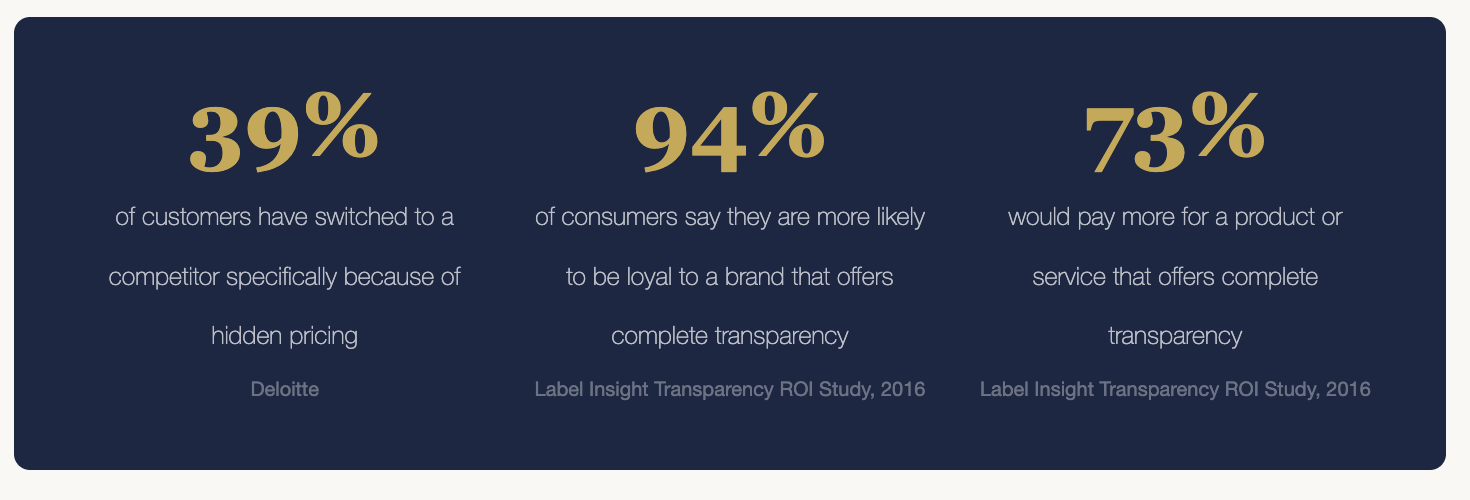
Read those numbers again. Nearly 4 in 10 potential clients are already choosing someone else before you get a chance to make your case. Not because you're too expensive. Because they didn't know.
The Psychology of "Contact for Pricing" (What Your Brain Hears vs. What You Mean)
You probably added "contact for pricing" because your services are custom, your prices vary, or you want to have a conversation before you throw a number out there. All totally reasonable. But here's what your potential client's brain actually does with that phrase:
Signal #1: "We're expensive — and we know it."
The whole "no price" thing started with luxury brands. Hermès doesn't tag their handbags. Michelin-starred restaurants don't post menus on the door. We've been trained to read hidden pricing as high pricing. Which is great if you're Hermès. But if you're a small service business trying to attract the right clients, that's a problem — because the people who could actually afford you are quietly assuming they can't and moving on.
Signal #2: "The price is negotiable."
No listed price implies wiggle room. Pricing psychology research shows that a number on your website carries way more authority than a number dropped on a discovery call. When there's nothing posted publicly, clients are more likely to push back, ask for discounts, or try to chip away at scope. Put it on the page first, and that number has gravity before you've even said hello.
Signal #3: "We don't trust you to make a decision without us."
People research before they reach out. That's just how buying works now. A "contact for pricing" button standing between someone and the information they need isn't a strategy — it's a roadblock. And roadblocks, when there are a hundred other options a Google search away, just send people elsewhere.
When your pricing is visible, the conversation shifts from 'let me convince you this is worth it' to 'let me tell you more about what working together actually looks like.' That is a fundamentally different energy.
Transparent Pricing Is a Trust Signal — and Trust Is What Actually Closes Clients
Pricing transparency isn't just about making things convenient for your potential client. It's about what showing your prices says about you.
When you publish your rates — even a range, even a starting point — you're sending signals whether you mean to or not.
Here's what the good ones look like:
You know what you're worth. Confidence isn't just a vibe — it's a business signal. Putting a number on your website says I've thought about this, I stand behind it, and I'm not going to make you drag it out of me. That reads as authority, not arrogance.
You respect their time. Giving people the information they need upfront — without a form, a call, or a waiting period — is just good hospitality. It tells them the experience of working with you will probably feel the same way.
You have nothing to hide. Hidden pricing plants a seed of doubt. Are there surprise fees? Will the scope balloon? What am I actually getting into? Visible pricing kills that doubt before it starts.
And here's the stat that should make you put down your coffee: a Label Insight study of over 2,000 consumers found that 94% are more likely to be loyal to a brand that's fully transparent — and 73% would pay more for it. More. Not the same. More.
The real frame shift is this: when someone can't find your price, they're asking themselves "Can I even afford this?" — pure anxiety mode. When your price is right there on the page, the question becomes "Is this worth it for me?" — which is a completely different, and much more buyable, headspace.
Same person. Totally different conversation.
How to List Your Prices When Your Services Are Totally Custom (Because Yes, You Can)
The number one reason service providers give for not listing prices is: "Every project is different." Valid. Also not the full story.
You don't need a flat rate for every possible scenario. You need to give people enough to self-qualify. There's a meaningful difference between "all pricing is bespoke, please inquire" and "here's the lay of the land." Here's what that actually looks like in practice:
Option 01 — The "Starting At" Number
Your minimum investment. Sets a floor, gives a compass, filters the wrong people out. "Websites starting at $4,500" immediately tells someone whether they're in the right ballpark — no call required.
Option 02 — Tiered Packages
Three options with clear inclusions. Leverages the compromise effect (more on that below). Great for businesses with defined service scopes. Name your tiers with intention — outcomes, not feature lists.
Option 03 — A Realistic Range
"Most clients invest between $X and $Y depending on scope." Honest, useful, still filters appropriately. Best for highly custom work where a single number would genuinely mislead.
Option 04 — Add-Ons, Clearly Listed
A visible add-on menu increases transparency and average project value simultaneously. Clients who came in for one thing suddenly notice the add-on they didn't know they wanted. No upselling required.
The goal isn't precision to the dollar. The goal is to give someone enough information to know whether they're in the right place — so that by the time they reach out, they've already decided they want to work with you.
The Psychology of Tiered Pricing (This Is Where It Gets Really Fun)
If you're going to list packages, a few psychology principles will make them work so much harder for you. And honestly? This stuff is fascinating.
The Compromise Effect
When people are presented with three options, they almost always choose the middle one. Almost always. It's so consistent it's practically a rule of human behavior.
Here's why this matters for your pricing: that middle tier isn't chosen because it's the best deal — it's chosen because it feels the most reasonable relative to the other two. The highest tier makes it look affordable. The lowest tier makes it look complete. You're not just listing options. You're designing a decision.
Real example: a Pilates studio offers a 5-class pack for $120, a monthly membership for $220, and an unlimited VIP membership for $380. Most people choose the $220. The $380 made it feel like a deal. The $120 made it feel like enough. Nobody had to sell anyone on anything.
Price Anchoring
The first number someone sees becomes their reference point for every number that follows. Lead with your premium tier and everything below it feels more accessible. Lead with your lowest tier and suddenly your mid-range feels expensive.
This is also why listing what's not included at lower tiers is so effective. When someone reads "second photographer not included" under a wedding photographer package, they don't think "great, I'll skip that." They think "wait, do I need that?" — and they start talking themselves into the upgrade.
The Self-Upsell
When your tiers are clear and the differences are obvious, something great happens: clients talk themselves into the higher package without you saying a word. They do the math, decide they don't want to give up the thing the next tier includes, and just... choose it. No awkward sales conversation. No "let me think about it." The page does the heavy lifting.
One more thing: name your tiers like a human, not a spreadsheet.
"Essential / Signature / Immersive" will outperform "Basic / Standard / Premium" every time. The first set signals an experience and a result. The second signals a cost tier. One of those makes people excited to choose. The other makes them feel like they're picking a cable package.
How You Frame the Price Matters as Much as the Number Itself
A price without context is just a number floating in space, waiting to scare someone off. A price with context is a decision. The words around your pricing do just as much work as the number itself — maybe more.
Here's what I mean:
Photographer:
Without Context: Photography $1,800
With Context: Portrait sessions start at $1,800 and include a pre-shoot style consultation, three outfit changes, and a private online gallery of 60 edited images.
Acupuncture:
Without Context: $95/session
With Context: Initial acupuncture sessions start at $95. Most clients leave feeling like a different person. Many book their second appointment before they've even put their shoes back on.
Financial Planner:
Without Context: Financial Planning — $2,500
With Context: Comprehensive financial plan starting at $2,500 — finally know exactly where your money is going, where it's been hiding, and how to make it work harder than you do.
See how different that feels? Same price. Completely different experience of reading it.
A few more framing things worth knowing:
"Investment" vs. "price" or "cost." This isn't fluffy marketing speak — it genuinely shifts how the brain processes the number. An investment implies you get something back. A cost implies money leaving. Use "investment" intentionally though, not plastered everywhere, or it loses its punch.
Lead with outcomes, land on the price. Your services page should answer "what's going to change for me?" way before it answers "what does this cost?" By the time someone gets to the number, the value should already feel obvious. Price is the last thing they read, not the first thing they see.
"Starting at" vs. a flat number. Both work. "Starting at" sets a floor, signals flexibility for custom scope, and manages expectations without locking you in. It also psychologically feels like an invitation rather than a verdict.
But Won't I Get Fewer Inquiries? (Yes — And That's the Point)
Let's address the fear head-on: if you post your prices and fewer people reach out, isn't that bad for business?
Only if you're measuring the wrong thing.
Every "contact for pricing" email you respond to, every discovery call you book with someone who disappears after hearing your rate, every hour you spend in back-and-forth that goes nowhere — that is unpaid work. It is your actual time, your actual energy, spent on people who were never going to become clients.
When your pricing is visible, the math changes:
People who reach out have already decided they can work with it.
The discovery call shifts from justifying your rate to confirming the fit. That is a fundamentally different conversation — and a much easier one to close.
You stop attracting price-hagglers.
The clients most likely to push back on your rates, ask for discounts, and make your life difficult are the ones who weren't aligned with your pricing from the start. Transparent pricing filters them out before you ever meet them.
Your own pricing conversations get easier.
Here's an underrated bonus: when your price is publicly listed, there's something grounding about saying it out loud. You stop hedging. You stop second-guessing in real time. Your website has your back.
A GENUINE CAVEAT
There are legitimate exceptions: government contracts with formal bidding requirements, highly regulated industries with price-control mechanisms, or truly one-of-a-kind bespoke services where no meaningful comparison exists. If that's genuinely you, this advice applies differently. But for most small service businesses? These exceptions aren't your situation — they're just a comfortable story to tell yourself about why you don't have to put the number on the page yet.
The Real Reason We Hide Prices (Let's Just Say It)
Most of us hide our prices because we're scared.
Scared the number will send people running.
Scared it's too high and we'll hear crickets.
Scared it's too low and we're accidentally announcing our imposter syndrome to the entire internet.
Scared that putting a number on the page is like getting a tattoo — permanent, visible, and something your mom will have opinions about.
Those fears are normal. They're also not a business strategy.
Here's what's actually happening while you're hiding behind "contact for pricing": someone who already loves your work and already stalked your Instagram is clicking through your services page looking for a number. Any number. And when they don't find one, they don't email. They just leave. Quietly. Without you ever knowing they were there.
They found someone else. Someone who had the audacity to just put the price on the page.
Your website is your hardest-working team member. Let it do the whole job.
The Bottom Line: Just Put Something on the Page
You don't need a flat rate for every possible scenario. You just need to give people enough to know whether they're in the right place. Here's what that actually looks like:
Post a starting point. The minimum investment to work with you. This alone will improve your lead quality overnight.
Consider tiered packages. Three options, clearly named, with the compromise effect doing the heavy lifting on which one they choose.
Surround the number with context. What's included, what outcome they can expect, why it's worth it. A price without context is just a number waiting to scare someone off.
Add a visible add-on list. Good for transparency, great for your average project value. Clients talk themselves into more comprehensive packages when they can see what's possible.
Frame it as an investment, not a cost. Lead with outcomes. Land on the number. Let the value be obvious before the price appears.

Your website is either working for you or working against you.
Let's make sure it's doing the first one.
See my website design services (prices listed, obviously) or book a free strategy call — and let's figure out exactly what yours is missing.